


Pixel Gem Loop: Gem Coloring
Shinrays Games
I picked up Pixel Gem Loop: Gem Coloring expecting a small, relaxing puzzle game, and that is exactly the space it occupies. The idea is easy to grasp: you work with colorful gem-like pieces, rotate or tap them, and gradually complete pixel-art patterns. The appeal is less about a dramatic story or complicated rules and more about the satisfying rhythm of making a messy-looking board become complete.
That simplicity makes it a good fit for short breaks. I can imagine playing it while waiting for an appointment, winding down before bed, or taking a few minutes away from a more demanding game. It is free to start, rated for Everyone, and comes from Shinrays Games. The store summary focuses on spinning, tapping, and filling pixel-art loops, but what matters in practice is how those actions combine into a steady sequence of tiny goals.
The game has attracted a 4.8 average from around 2.6 thousand ratings and has passed 100 thousand installs. Those figures suggest that its compact puzzle format has found an audience, although they do not replace personal taste. If you want a deep logic challenge, a campaign with characters, or a competitive leaderboard, this is probably not where you should begin. If you enjoy visual completion and gentle interaction, it is much easier to recommend.
How the puzzle loop builds momentum
The first goals are clear, quick, and visual
The strongest part of the opening experience is that the objective is visible. Instead of asking me to learn a large rulebook, the game puts the focus on matching and filling. A piece that is out of place is usually easy to recognize, and the act of correcting it gives immediate feedback. That creates a natural first goal: understand the relationship between the pieces, then finish the pattern without overthinking it.
This is a useful design choice for a casual puzzle game. I do not have to remember a story objective or prepare a strategy before starting. The board itself tells me what needs attention. For a child or a player who rarely plays puzzle games, that directness lowers the barrier to entry. The Everyone age rating also suits the approachable presentation, though younger players may still need guidance around optional purchases.
Related News






The early stages are best treated as a tutorial through action rather than a lesson filled with instructions. I found it more helpful to watch how a rotation changes the shape of the loop than to rush through taps. A practical tip is to pause for a moment before making the first move. Looking for the pieces that already seem close to their final position can reveal the intended structure and reduce unnecessary corrections.
That small habit becomes important because the game’s satisfaction comes from order emerging gradually. The first completed sections act as encouragement, while the unfinished areas keep the next target obvious. There is no need to invent a plan several minutes ahead when the immediate visual problem is already in front of me.
Progress is communicated through completion rather than complexity
Pixel Gem Loop: Gem Coloring does not need a complicated progression explanation to make progress feel real. Each finished design is a visible result, and the transition from scattered gems to a completed pixel-art image provides its own reward. I like this because it keeps the focus on the puzzle rather than surrounding it with systems that could distract from the central action.
Gallery
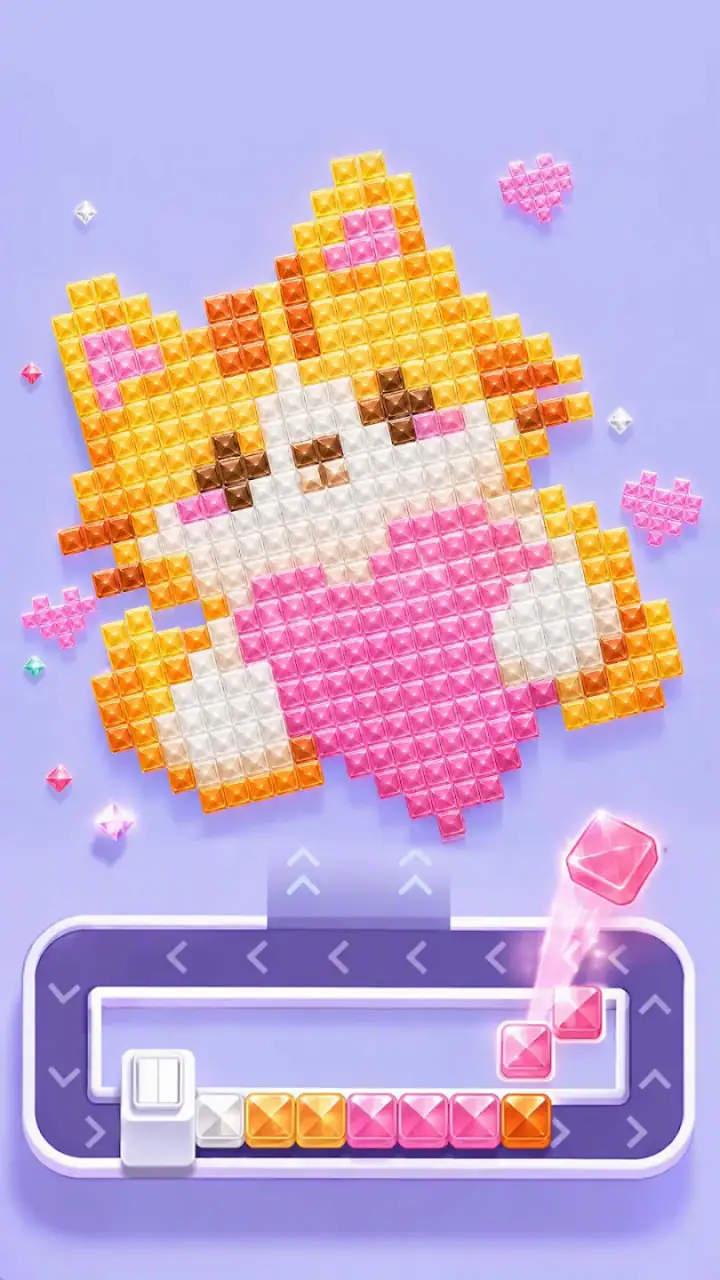
The progress signal is especially effective for players who enjoy collecting completed things but do not want a demanding schedule. A short session can still end with a clear sense of accomplishment. I can stop after finishing a pattern without feeling that I have abandoned a long mission halfway through. That makes the game more flexible than many puzzle titles that rely on extended runs or fixed daily commitments.
There is also a useful difference between visual progress and numerical progress. A percentage or score can tell me that I am advancing, but a completed image shows why the advancement matters. Here, the picture becomes the record of the work. That is a good match for the coloring-inspired format and gives the game a calmer identity than traditional match-three puzzles built around score chasing.
My advice is to judge a session by the quality of the completed pattern, not by how quickly every piece is placed. Rushing can turn a relaxing activity into repetitive correction. Taking a second to inspect the loop often makes the next move more obvious, especially when several similar gems are close together.
The difficulty curve depends on attention more than pressure
The challenge in this kind of game comes from recognizing orientation, position, and visual relationships. That means difficulty can rise without requiring faster fingers. A later puzzle may feel harder simply because more pieces look similar or because the correct arrangement is less immediately obvious. I appreciate that type of challenge because it rewards observation rather than reflexes.
At the same time, players should not expect the difficulty curve of a traditional logic game. The experience is built around accessible manipulation, not around elaborate deduction or severe punishment. Someone looking for brain-burning puzzles may find the loop too gentle, particularly after the novelty of completing the first patterns fades. The game is better understood as a relaxing visual puzzle with moments of concentration.
One technique helped me avoid getting stuck: I worked from the edges and distinctive shapes toward the less obvious center pieces. A corner or unusual color combination gives more information than a cluster of nearly identical gems. This approach also limits random tapping, which is important because guessing can make the board feel more confusing than it really is.
Another useful approach is to rotate only when I have a reason. If a piece appears almost correct, I compare its neighboring colors or shapes before changing it. That reduces the chance of disturbing a section that was already aligned. These are small decisions, but they make the difference between a calm puzzle session and a cycle of trial and error.
Pacing works best in short, repeatable sessions
The pacing is one of the game’s clearest strengths. Its basic interaction is quick to understand, and the visual completion loop naturally supports short play. I do not need a large uninterrupted block of time to enjoy it. That makes it a practical choice for commuters, people taking screen breaks, or anyone who wants a low-commitment activity between larger tasks.
A realistic use case would be a ten-minute evening break after work. I could open the game, complete part of a pattern, and stop when my attention starts to drift. There is no need to remember a complicated sequence for the next day. Returning later should feel approachable because the visual state of the puzzle provides an immediate reminder of what remains.
The same pacing can become a limitation. If I play for a long stretch, the repeated rhythm of spin, tap, and fill may start to feel similar from one puzzle to the next. The game is not designed to replace a full-length adventure or a strategy session. Its strength is that it asks little of me; its weakness is that it may not offer enough variety for players who want constant novelty.
This is where the game compares favorably with many match-three alternatives. Those games often emphasize chains, timers, lives, or high scores, creating a more urgent loop. Pixel Gem Loop: Gem Coloring feels more deliberate because the goal is completion of a visual arrangement. On the other hand, a conventional logic puzzle may provide more depth, while a coloring app may offer more freedom. This game sits between those choices: it supplies structure without demanding speed, and color without offering unlimited creative control.
Unlocks and goals should support play, not replace it
The most convincing goal in the game is still the next completed design. That sounds modest, but it gives the experience a clean focus. I am not opening it because I need to manage a large collection of resources or maintain a complicated build. I am opening it because finishing a pattern feels pleasant and achievable.
For me, that kind of goal is enough when the puzzles remain visually satisfying. It also makes the game suitable for players who dislike heavy progression systems. There is less mental overhead between starting the app and doing the thing I came to do. The trade-off is that players who need character upgrades, narrative milestones, or strategic unlocks may find the motivation too light.
The current version is 1.301, and the game is available for devices running Android 6.0 or later. That broad compatibility makes it easier to consider on an older phone or tablet, provided the device handles the game comfortably. The title is free to download, but in-app purchases range from $1.99 to $99.99 per item. I would recommend approaching those options carefully and deciding in advance whether the basic loop already gives enough value.
That price range matters because a relaxing puzzle can encourage impulse spending when a player is trying to keep momentum. I prefer to treat purchases as optional rather than part of the reason to start. If the free experience already suits my short-session routine, I do not need to turn a simple pastime into a larger expense. Families should also make sure purchase controls are set appropriately, even though the game itself is rated Everyone.
Where retention helps and where it can become pressure
The game’s retention comes most naturally from unfinished visual work. Seeing a nearly complete loop makes me want to return and place the last pieces. That is a healthy form of motivation because it is tied directly to the puzzle in front of me, not to fear of losing a streak or missing a timed event. I can play when I want and stop when I want.
Still, any repeatable puzzle loop can become repetitive if the player expects constant escalation. The absence of urgency is relaxing, but it also means the game has to rely on the appeal of its patterns and interactions. If those stop feeling fresh, there may be little else to pull me through a long session. This is the main retention trade-off: low pressure makes the game welcoming, yet low pressure can also reduce the need to return immediately.
I think the best way to use it is as a small part of a broader phone routine. I would not make it the only game on my device. Instead, I would keep it for quiet moments and switch to a deeper puzzle or a more active game when I want stronger challenge. That division of roles makes its simplicity feel intentional rather than incomplete.
Players who are sensitive to monetization should make the same distinction. The free entry point is appealing, but the presence of optional items means the experience should be evaluated by what can be enjoyed without spending. For a casual player, that may be perfectly acceptable. For someone looking for a fully self-contained premium puzzle, a paid title with a fixed price may be a better fit.
Who will enjoy it most
I would recommend this game to people who like pixel-art presentation, gentle matching, and visible completion. It is a particularly good choice for players who want something easy to start but still engaging enough to occupy their hands and eyes. The controls are suited to touch, and the core objective is understandable without long explanations.
It may also work well for families looking for an accessible puzzle format. The Everyone rating makes the audience broad, while the visual nature of the tasks can be easier to follow than text-heavy logic games. I would still supervise purchase settings for children, because the free game includes optional items with different prices.
I would skip it if my main goal were competitive performance, complex planning, or a long narrative. I would also look elsewhere if I wanted an open-ended coloring tool where I could freely choose every color and draw without constraints. Here, the pleasure comes from solving a designed arrangement. That structure is the reason to play, but it is also the boundary of what the game offers.
Compared with a standard match-three game, this is calmer and less dependent on speed. Compared with a pure coloring app, it gives me more direction and a clearer sense of solving something. Compared with a serious logic puzzler, it is lighter and more visually soothing. Those comparisons place it in a useful middle ground, as long as I approach it for relaxation rather than depth.
My verdict on the progression and long-term appeal
After spending time with Pixel Gem Loop: Gem Coloring, I see a focused puzzle game that understands the value of small goals. Spinning and tapping pieces into completed pixel-art loops creates a pleasant rhythm, and the visible results make short sessions feel worthwhile. Shinrays Games has kept the central idea easy to access, which is why the game can appeal to casual players, families, and anyone who prefers a quiet alternative to faster puzzle formats.
The progression is convincing when I treat each pattern as its own achievement. It is less convincing if I expect a deep campaign, major strategic unlocks, or a constantly changing challenge structure. The difficulty rewards careful observation, but it is unlikely to satisfy players searching for punishing logic problems. The pacing is similarly balanced: excellent for brief breaks, less compelling as an all-day game.
My practical recommendation is to try it during the kind of moment when you want a calm activity rather than a demanding one. Start by studying the edges, use distinctive pieces as anchors, and avoid random rotations when a section is already close to correct. Those habits make the visual loop clearer and help preserve the relaxing mood.
Overall, I think this is a worthwhile free puzzle for players who enjoy tidy visual goals and uncomplicated touch interaction. Just keep the optional purchases in mind, especially if children will use the device, and be honest about what you want from the game. If you want a peaceful way to complete colorful patterns, it is an easy recommendation. If you need competition, narrative, or substantial strategic depth, another puzzle category will serve you better.
FAQs for Pixel Gem Loop: Gem Coloring
What is Pixel Gem Loop: Gem Coloring?
Pixel Gem Loop: Gem Coloring is a relaxing mobile coloring game that combines pixel-art artwork with colorful gem-filling mechanics. You select an image, follow its numbered or highlighted sections, and complete the design by placing the correct colors. The experience is designed for casual play, with simple controls and a focus on creativity, concentration, and stress relief rather than fast-paced competition.
How do you play Pixel Gem Loop: Gem Coloring?
To play, choose a picture from the available collection and zoom in on the pixel-style canvas. Each area indicates the color or gem needed, and you tap the matching sections to gradually complete the artwork. The controls are straightforward, making the game suitable for short sessions. Depending on the version and level, hints or assistance may be available when locating small or difficult sections.
Is Pixel Gem Loop: Gem Coloring free to download and play?
The game can generally be downloaded without an upfront purchase, but free access may include advertising, optional in-app purchases, or restrictions on certain images and features. Before installing, check the store listing for the current pricing model, subscription details, and purchase information. If you prefer uninterrupted coloring, paid options may be offered to remove advertisements or unlock additional content.
Does Pixel Gem Loop: Gem Coloring work offline?
Many of the coloring activities may be playable without a constant internet connection once the required content has loaded, which makes the game convenient for travel or offline breaks. However, advertisements, new picture downloads, cloud synchronization, updates, and in-app purchases may require internet access. Availability can vary by device and app version, so test the game offline after installation.
Is Pixel Gem Loop: Gem Coloring suitable for children?
Pixel Gem Loop: Gem Coloring is generally easy for children to understand because it uses tapping, color matching, and simple visual instructions. Nevertheless, parents should review the age rating, advertising behavior, and available in-app purchases before allowing independent play. Some artwork or promotional content may not be intended for every age group, and parental controls are recommended for younger users.
Pros
- Relaxing color-by-number gameplay suitable for short breaks.
- Bright gem visuals make completed pictures look satisfying.
- Simple controls are easy for children and casual players.
- Many designs offer a pleasant creative activity without drawing skills.
- Offline play may be convenient when traveling or away from Wi-Fi.
Cons
- Repetitive tapping can become monotonous after extended sessions.
- Small gem areas may be difficult to select on compact screens.
- Some artwork or tools may require in-app purchases to unlock.
- Frequent ads can interrupt the coloring flow between pictures.
- Limited creative freedom compared with fully freeform coloring apps.


